Most project failures do not happen suddenly. They accumulate — quietly, over months — until the day someone asks a question that nobody can answer. A risk register that has not been updated. A timeline that was optimistic three months ago and is now quietly impossible. A scope that has grown without anyone formally agreeing to the change.
A project health check is a structured assessment designed to surface these issues before they compound into delivery failure. Whether you run one yourself or commission an independent review, the value is the same: an honest, evidence-based picture of where your project stands — and what needs to change.
When to Run a Health Check
Not every project needs a health check every week. But there are moments when the cost of not knowing exceeds the cost of finding out:
- •Before a governance gate or funding decision — Stakeholders are about to commit resources. They deserve an accurate picture.
- •When status reports feel unreliable — If you suspect the RAG status is more optimistic than reality, a health check provides independent evidence.
- •After a significant change — New scope, new leadership, a missed milestone, or a shift in business priorities all warrant a fresh assessment.
- •At regular intervals on long-running programmes — Quarterly health checks prevent drift from becoming entrenchment.
- •When you inherit a project — A health check gives incoming leads a baseline rather than relying on inherited assumptions.
The common thread: these are the moments when assumptions become expensive.
What a Good Health Check Assesses
A thorough project health check examines six dimensions:
1. Objectives and scope alignment
Are the project objectives still aligned with the business outcomes they were designed to deliver? Has scope changed — formally or informally — since initiation?
2. Governance and decision making
Are decisions being made by the right people, with the right evidence, at the right pace? Are escalation routes clear and used?
3. Risk and issue management
Are risks identified, owned, and actively managed? Are issues being resolved or just logged? Is there a difference between what is in the risk register and what people actually worry about?
4. Schedule and milestones
Is the timeline realistic given current progress? Are dependencies mapped and managed? Has the critical path shifted since planning?
5. Team capability and capacity
Does the team have the right skills and enough capacity to deliver? Are there single points of failure? Is morale affecting productivity?
6. Stakeholder engagement
Do key stakeholders share the same understanding of success? Are communications effective — or is the project team operating in isolation?
Each dimension should produce a clear finding: what is working, what is not, and what action is recommended.
The Manual Approach — and Its Limits
Traditionally, a project health check means assembling a review team, scheduling interviews with key stakeholders, gathering and reading project documentation, and synthesising findings into a report.
Done rigorously, this process takes two to four weeks and requires experienced reviewers who understand delivery methodology, governance frameworks, and organisational context. The output is valuable — but the time, cost, and availability constraints mean most projects never receive one.
The consequence is familiar: health checks happen for the flagship programme because the board insists. Everything else relies on self-reported RAG statuses and the hope that no one asks too many questions. The projects most at risk are the ones least likely to be reviewed.
How AI Delivers Health Checks in Hours
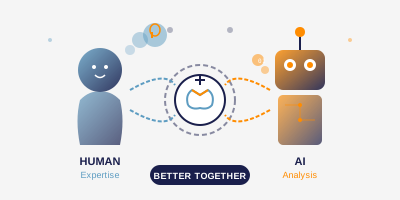
AI does not shortcut the rigour. It compresses the timeline. Revue-ai's Project Review follows a structured six-step process that mirrors what a consulting team would do — at a fundamentally different speed:
- 1.Define the review — Select your review type and methodology. Set objectives.
- 2.Upload documentation — Project plans, risk registers, status reports, business cases. All major file types supported.
- 3.AI-guided assessment — A structured conversation captures context, challenges, and team perspective that documents alone cannot provide.
- 4.Analysis — AI processes your documentation against industry benchmarks, best practice frameworks, and pattern recognition across delivery data.
- 5.Report generation — A 25+ page assessment with Success Probability score, RAG status, risk traffic lights, methodology scores, and prioritised recommendations.
- 6.Validation — Review, verify, and provide feedback before final delivery. The human stays in the loop.
The result is a consulting-grade health check delivered in hours, at 90% less cost, available on demand.
The question is not whether your project needs a health check. It is whether you can afford to find out too late that it did.
A structured health check is the single most effective way to convert uncertainty into evidence — and evidence into action.
Questions Worth Asking
- •Which projects in your portfolio have never received an independent health check?
- •If you ran a health check on your most critical project today, would the findings surprise you?
- •What is the cost of discovering a major risk three months from now instead of this week?
Try It Now — Free Project Health Check
Get an instant health score for your project across 5 key dimensions. Takes 2 minutes, no sign-up required.
Further Reading
- Project Health Pulse — Free instant health check for your project. Score 5 dimensions in 2 minutes.
- How Reviews Work — See our six-step review process in detail.
- Delivery Insights — Explore the full suite of AI-powered intelligence products.
- What Is Programme Assurance? — Why independent scrutiny matters at programme level.